
Hi all! This post will be a quick introduction to my beautiful field site, Hawk Mountain Sanctuary (I’m going to keep shamelessly plugging/linking this place – seriously, go visit in the fall. It’s fantastic), as well as a peak into some of my fieldwork over the past couple weeks.
Hawks, conservation, and killer views:
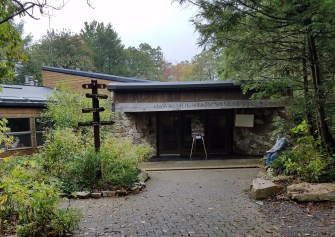 Hawk Mountain is a picturesque wildlife preserve located in the Appalachians in southeastern Pennsylvania. The ~ 2,600 acre refuge was established in 1934 as not only a sanctuary for birds of prey, but as a center for raptor research and conservation as well. Staff members, interns, and volunteers are involved in raptor conservation science and education year-round at the site. One of my favorite aspects of education at the site are the “Raptors Up Close” seminars at the visitor center (pictured above) where visitors can learn about birds through (rescued) raptor demonstrations.
Another really cool part of the research at Hawk Mountain is the raptor count – staff from the site count raptor sightings at “North Lookout,” a spot where visitors can view migrating raptors as the birds travel along the Kittatinny Ridge (it’s especially great in the fall). Hawk Mountain uses these raptor counts to monitor and better understand migration patterns and timing. The video below captures the view from the lookout from Saturday, Nov. 11, 2017 (video is my own).
Imagine seeing thousands of Broad-winged Hawks flying right toward you from over that ridge – you can see it for yourself if you visit Hawk Mountain during fall migration! Want more info? Visit their webpage or follow them on Twitter @Hawk_Mountain (I warned you – shameless mentions galore).
Fieldwork and feeder fun:
Shifting gears a little bit, I want to give a quick update on fieldwork over the last couple of weeks at the sanctuary.
Unfortunately, until this past week, the weather has been painfully mild. Seventy-two degrees in November is crazy (hey guys, climate change is real). This means the birds were still relying mainly on natural food sources as well as the reliable (and consistent) feeders at the sanctuary’s visitor center – so my temporary feeders (placed in wooded locations around the site) weren’t getting much, or any, action. When your research relies on feeder activity, this gets pretty discouraging, especially because we had active feeders in early October last year.
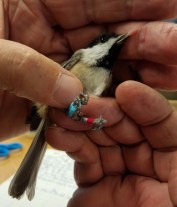
 BUT, thanks to a severe drop in temperature this past week (see left), things are looking up! We were able to mist-net and band 6 new chickadees and recapture a few as well. We even recaptured a bird from 2012 who had avoided capture for 5 years at the site (see below; right). Although 6 new birds may not seem like that many, it means the start of more promising netting and banding days, which are obviously crucial to my research. Importantly, 4 of my 8 feeders around the site are now active – even at a part of the site where feeders from last year were never located by the birds. I am a much happier researcher this week compared to the beginning of the fall season!
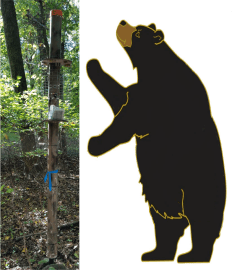
I also tried out a brand new RFID* feeder design at Hawk Mountain on Saturday, Nov. 11. In fall/winter 2016, I built and installed semi-permanent PVC-pipe RFID feeders (see below; left) around the site. I added a cage to the feeders to prevent squirrel damage and to discourage other larger birds from eating the seed; however, the cage was not able to prevent attack from a much larger predator – the Black Bear. My data collection was interrupted by a bear destroying my feeders (which were easy targets staked into the ground) many times through the winter – but luckily the bear and I never met (until this past spring – but that’s a story for another post).
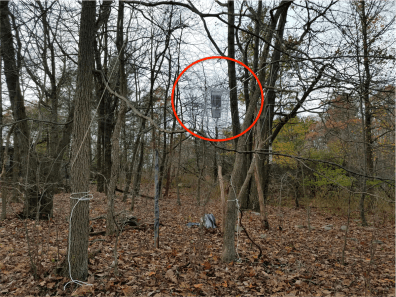
My new feeder design can be strung up between trees (see below; left), high enough to hopefully deter Black Bear depredation. The cage is much sturdier structurally and will also prevent some larger birds from dwindling the seed. This new feeder design is more efficient and is much easier to deal with in the field because the entire feeder module (feeder + electronics) can be pulled from the bottom of the cage for management. The electronics are visible (see below; right), but still secure and protected away from squirrel and other predators. I’m excited to install a few more of these at active temporary feeder locations next week, with the end goal being to have 8 active RFID feeders spread out through the entire site.

There will definitely be more to come with regard to fieldwork updates as the winter season progresses and it continues to get colder. Thanks for reading and feel free to “like,” share, or follow my blog if you’re interested in keeping up with my research!
*Radio Frequency Identification – see research for more information
 Rebecca Garlinger