
As a scientist, I aim to study the importance of social ecology in fitness, selection, and conservation throughout my career. I believe that understanding the ways in which social animals communicate, associate, and interact provides a window into how these animals survive and persist in the wild. Currently, I am working toward my masters degree in an ornithology lab at Villanova University studying avian social ecology in two species of passerine and their hybrids (see below).
Dominance and mate choice: An analysis of behavioral mechanisms in a moving songbird hybrid zone
(M.S. Thesis – In progress)
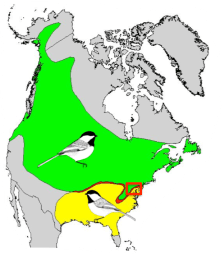 Black-capped Chickadees (Poecile atricapillus; green range) and Carolina Chickadees (Poecile carolinensis; yellow range) come into parapatric contact along a narrow zone stretching from New Jersey to Kansas. In this contact zone, the two species hybridize and produce viable and fertile offspring. My study site, Hawk Mountain Sanctuary in Kempton, Pennsylvania, is currently in the center of this chickadee hybrid zone.
This zone, like many others, has been shifting northward rapidly (rate of ~ 1km per year). Our lab, in collaboration with the Lovette Lab at Cornell University has demonstrated that this movement is in parallel to the northward expansion of the Carolina Chickadee range and an increase in minimum winter temperatures. Climatically suitable habitat for Black-capped Chickadees exists south beyond the hybrid zone however, yet the species is not filling this niche, suggesting behavior may contribute to northern zone movement as well.
 Aviary study suggests that females of either species prefer Carolina males over Black-capped after watching the males interact. Work in the field indicates that females choose Black-capped-like males as extra pair sires more often than Carolina males, but whether this was based on social cues is unknown. My work will determine if winter social behavior driving asymmetric mate choice (in favor of Carolina males) may be influencing species boundaries and hybrid zone movement.
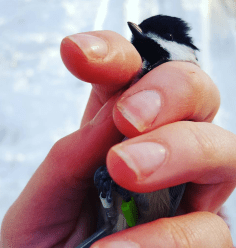
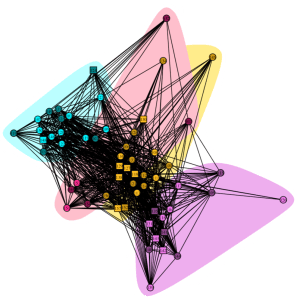
My methodology involves fitting chickadees with passive integrative transponder (PIT) tags, which contain unique electronic codes, and tracking their movements using radio frequency identification (RFID) equipped feeders. I will employ social network analysis (example network below) to elucidate species’ associations as well as a novel dominance assay method to determine hierarchies between species and among flocks.
 The Curry Lab uses artificial nest snags at Hawk Mountain to attract breeding chickadees and to obtain data about their nesting behavior. I aim to compare winter social behavior to spring mate choice data to determine if sociality and dominance (and/or genotype) influence mate choice.
My study will be the first to use social network analysis (SNA) to determine if social ecology influences mate choice in a moving hybrid zone.
To learn more about my study site at Hawk Mountain Sanctuary, about other research (chickadee personality, avian malaria, neotropical todies) happening in the Curry lab at Villanova, or about any of our other field sites in southeastern, Pennsylvania, visit the Curry lab webpage!
 Rebecca Garlinger